
Humanities
(English Language Arts and Social Studies, Gr. 5-6)
Introduction: About the Sammamish River Trail:
https://your.kingcounty.gov/dnrp/library/2002/kcr1270/02_Chapter_2.pdf
https://storymaps.arcgis.com/stories/061ad2b252944a4dbf6d0a7c872ea134
Reading: Informational Text (RI.7.1: Cite textual evidence to support analysis; RI.7.2: Determine central ideas and summarize)
Writing: Journaling through Narratives (W.7.3: Write narratives using descriptive details; W.7.4: Produce clear, coherent writing; W.7.10: Write routinely (journaling))
Language: Using Sentence Variety with Correct Use of Capitalization, Punctuation, and Spelling (L.7.1: Demonstrate command of grammar (phrases, sentence variety); L.7.2: Correct capitalization, punctuation, spelling; L.7.3: Use language effectively for description)
Sample Lesson:
Brain Cells Warm Up: Notice & Wonder: “Imagine walking along a river trail. What do you notice?” Draw it and label. TBTI (to be turned in)
Read the essay (printed and shared):
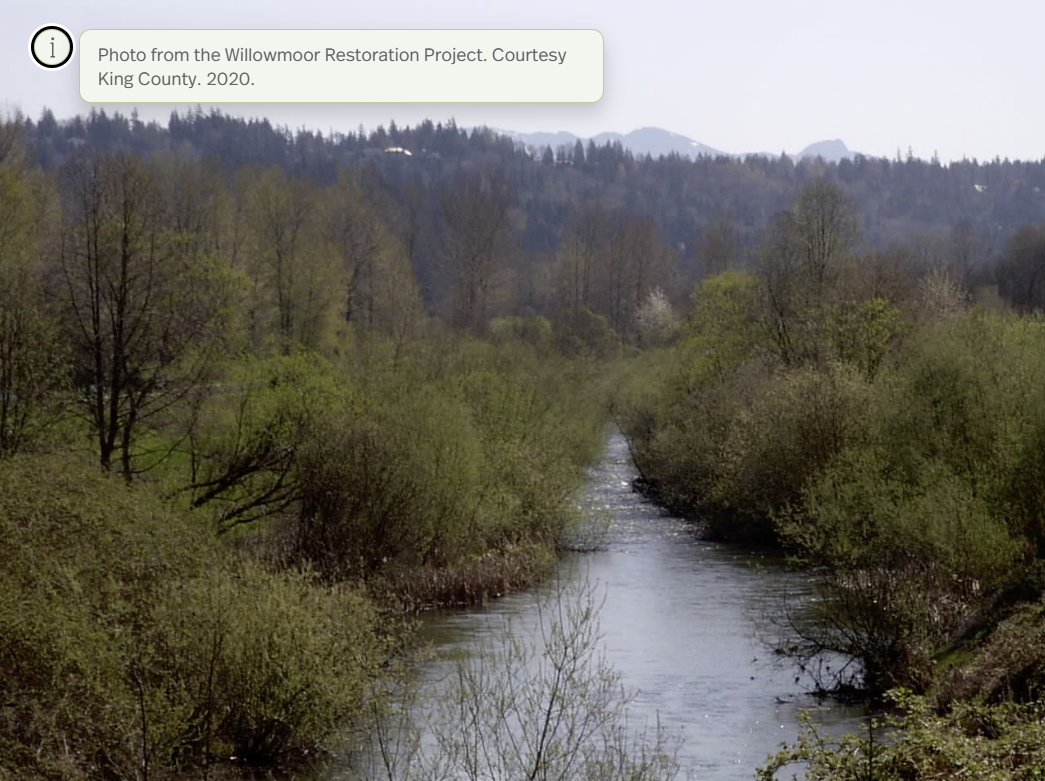
The Sammamish River has changed a lot from its original form. It used to curve naturally and had thick vegetation along its banks, which kept the water cool and provided shelter for wildlife. Over time, people straightened the river, deepened it, and removed much of the native plant life to reduce flooding and make the area easier to manage. These changes helped nearby communities, but they also disrupted the river’s natural systems.
Today, salmon and other fish struggle because the river no longer offers the conditions they need. Without trees and shrubs to block sunlight, the water warms up quickly in the summer. Warmer water holds less oxygen, which makes it harder for salmon to breathe and complete their migration. The river also lacks hiding places, food sources, and calm areas where fish can rest. All of these missing features make survival more challenging, especially during critical parts of the salmon life cycle.
Scientists and local groups are working to restore the river so it can support healthy ecosystems again. Planting native trees and shrubs can bring back shade and cooler temperatures. Adding logs, rocks, and other natural structures can create safe habitats for fish. In some areas, reshaping the river to include more natural curves may help slow the water and improve conditions. These efforts take time, but they can gradually rebuild a river environment where wildlife can thrive.
3. Quick Discussion Questions:
What is the central idea of the passage?
How has the river changed over time?
Why is the river important to both people and nature?
4. Grammar Mini-Lesson (~10–12 min)
Focus: Descriptive Phrases & Sentence Variety
A. Prepositional phrases (e.g., along the river, in the wetlands)
B. Adjective phrases (e.g., covered in tall grass)
C. Combining short sentences into richer ones
Examples:
Basic: The river flows.
Expanded: The quiet river flows through the wide valley, under tall trees.
Student Practice (Quick): Revise:
“The trail is long. People walk there.”
→ Students combine and expand
5. Writing Activity – Nature Field Notes (~20 min)
On Field Study Outing: Students observe real surroundings.
In class: Use imagination, videos or images.
Field Journal Prompt: Write a journal entry as if you are walking along the Sammamish River Trail or any river trail for now. Include:
3 sensory details (see, hear, smell)
1 historical detail from the reading
At least 2 descriptive phrases
1 varied sentence (compound or complex)
Sentence Starters (Scaffolding)
Along the river, I notice…
Long ago, people here…
The air smells like…
I hear… as…
6. Share & Reflect (~8–10 min)
Students:
Share 1 sentence with strong description
Identify a grammar move they used
Teacher listens for:
Use of descriptive phrases
Connection to history
7. Exit Ticket/Journaling (~3–5 min)
a. One thing you learned about the Sammamish River or a river trail:
b. One descriptive phrase you used:
Assessment (Informal)
Participates in discussion
Journal writing (check for CCSS alignment)
Grammar usage in context used correctly
Great extended ideas:
Sketch + label parts of the river ecosystem
Compare “past vs present” river in writing
Add a map activity (trace the 10-mile trail)
Why are we doing this?
To integrates ELA + science + local history
To build real-world connection to a nearby place
To practices grammar in authentic writing
To prepare for field-based learning